


Good wayfinding does something specific in a commercial building. It gives people confidence about where to go next before they consciously decide to look for a sign. In daylight, that job usually falls to architectural cues (broad corridors, sightlines, clear signage). But when the sun goes down or the house lights come up, most
buildings lose half of their wayfinding language. That's where integrated lighting comes in, and it's where railing systems become one of the most useful surfaces in the entire building.
An LED-integrated handrail runs continuously along the edge of every stair, ramp, walkway, and balcony where people actually move. It marks level changes without a sign. It illuminates the path of travel at exactly the height a hand would reach for it. It reinforces the shape of the space at night the same way daylight does during the day. And in an emergency, it becomes a continuous line of light that leads directly to the exit.
Here's a real look at how integrated railing lighting works for safety and wayfinding, where it earns its specification in commercial projects, and how VIVA has delivered iRAIL LED systems on real hospitality, entertainment, and civic venue projects.
Why Integrated Lighting Solves the Wayfinding Problem
Wayfinding is often thought of as a signage question. It's actually a perception question: users need to intuit the correct path of travel before they consciously read a sign. Integrated lighting solves this in ways signage cannot.
Continuous linear light reads as directional. The human eye follows a continuous line of light almost involuntarily. When that line runs along a handrail, the eye follows it up a stair, along a corridor, or around a mezzanine, and the path of travel becomes intuitive before it's cognitive. Signage can only mark decision points; inte
grated railing lighting communicates continuously.
Level changes get marked without extra hardware. In transition zones (stair top and bottom, ramp entry and exit, threshold crossings), integrated lighting makes elevation change visible from a distance. Users adjust their gait naturally rather than reacting at the last moment. That's a safety and wayfinding benefit at once.
Egress becomes a continuous line of light. In an emergency, when overhead lighting may be compromised and users are moving under stress, an illuminated railing that runs continuously to the exit is easier to follow than a series of exit signs. This is why NFPA 101 (Life Safety Code) permits and encourages continuous low-level path-of-egress lighting in assembly occupancies, and why railing-integrated LED is increasingly specified as part of the egress lighting strategy in theaters, concert venues, healthcare facilities, and transportation hubs.
Ambient light supports occupancy without competing with content. In theaters, restaurants after dark, hospitality corridors, and cinema lobbies, overhead lighting has to stay low to preserve the experience. Integrated railing lighting provides the ambient level needed for safe passage without pulling attention away from the stage, the food, the artwork, or whatever the space is built around.
Where Integrated Railing Lighting Earns Its Specification
Some commercial applications benefit from integrated lighting more than others. Here are the environments where it consistently pays back the investment.
Theaters, concert venues, and amphitheaters need low ambient light that supports safe navigation without disrupting the performance. Integrated handrail lighting is one of the cleanest ways to solve this because the light is exactly where the user's hand is, at exactly the level needed for footing, without spilling upward onto the seating area or stage.
Casinos, entertainment venues, and after-hours hospitality operate under low ambient light for atmosphere. Integrated railing lighting keeps stairs, mezzanines, and elevated walkways safely navigable while contributing to the design language of the space rather than fighting it.
Corridors and stairwells with dim ambient conditions (healthcare facilities, hospitality corridors after quiet hours, transportation terminals) benefit from continuous handrail illumination because it marks the path of travel and provides a tactile-visual reference for users who may be tired, disoriented, or physically compromised.
Exterior walkways, curbside canopies, and rooftop terraces need path-of-travel lighting that doesn't require pole-mounted or overhead fixtures cluttering the design. Integrated railing lighting delivers illumination at exactly the right height for footing while preserving the visual openness of the space.
Emergency egress paths in assembly occupancies are increasingly specified with continuous low-level illumination as part of NFPA 101 compliance. Integrated handrail LED is one of the cleanest ways to add this layer of safety without requiring a separate emergency lighting infrastructure.
Curved and non-linear architectural moments benefit specifically from integrated lighting because standard fixture spacing doesn't follow a curved handrail cleanly. Integrated LED bends with the rail.
Featured Projects: iRAIL LED Systems in Action
Here are four real projects showing how integrated railing lighting delivers on safety and wayfinding across different commercial environments.
Andretti Fort Worth — Fort Worth, TX
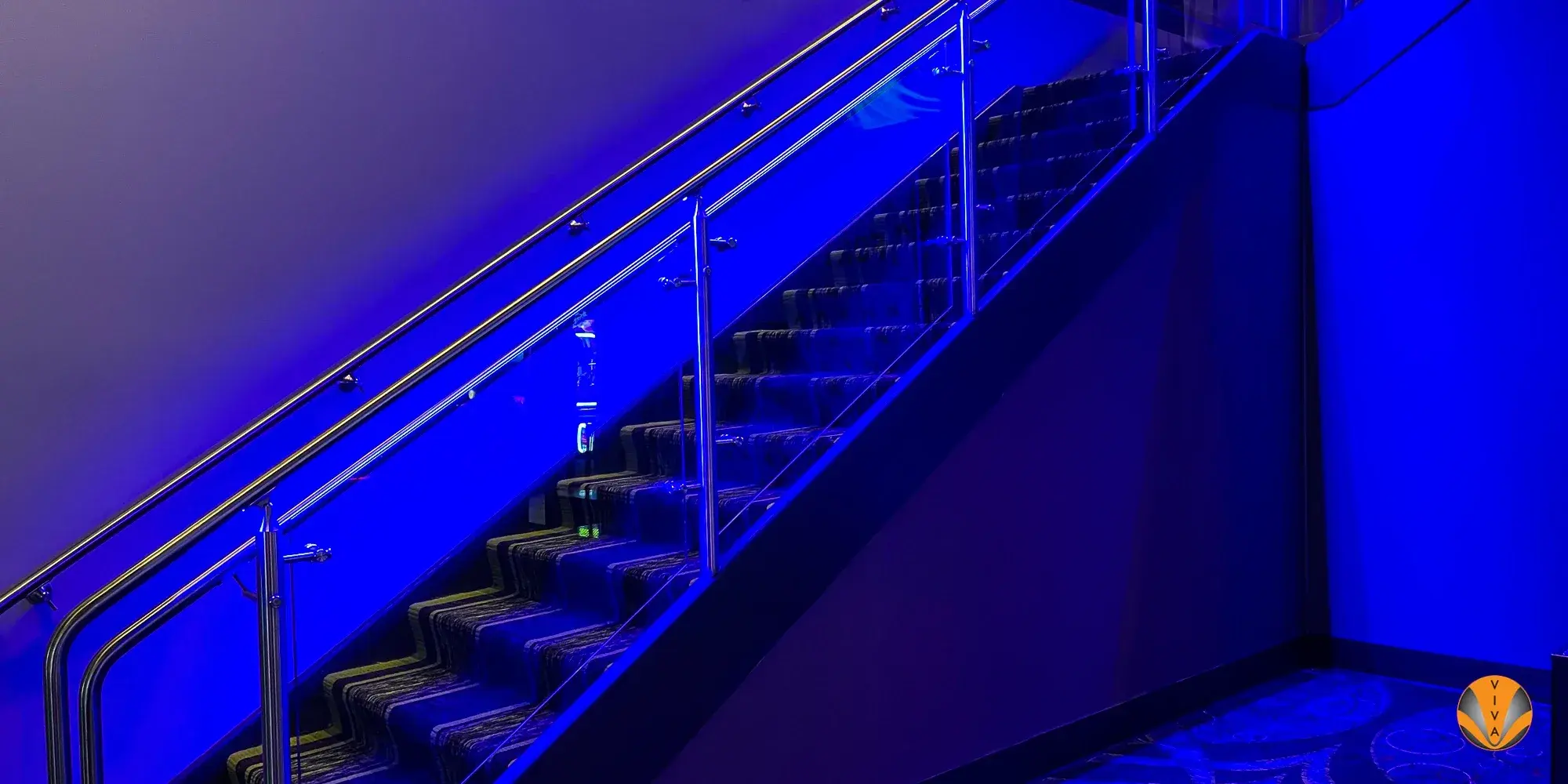
Andretti Fort Worth uses the CIRCA Glass Railing System paired with iRAIL Linear illumination to create a lit railing that fits directly into the entertainment-driven atmosphere. The combination delivers safety at low light hours while contributing to the ambient design of the space. Architect: 5G Studio. General Contractor: Parkway Construction & Architecture.
The Andretti Fort Worth and Andretti at The Colony pairing shows something worth noting: integrated lighting doesn't just serve the individual project. It reinforces brand and design language across a portfolio of related venues. Guests who visit one location recognize the lighting cues at the next.
Choctaw Casino & Resort — Durant, OK
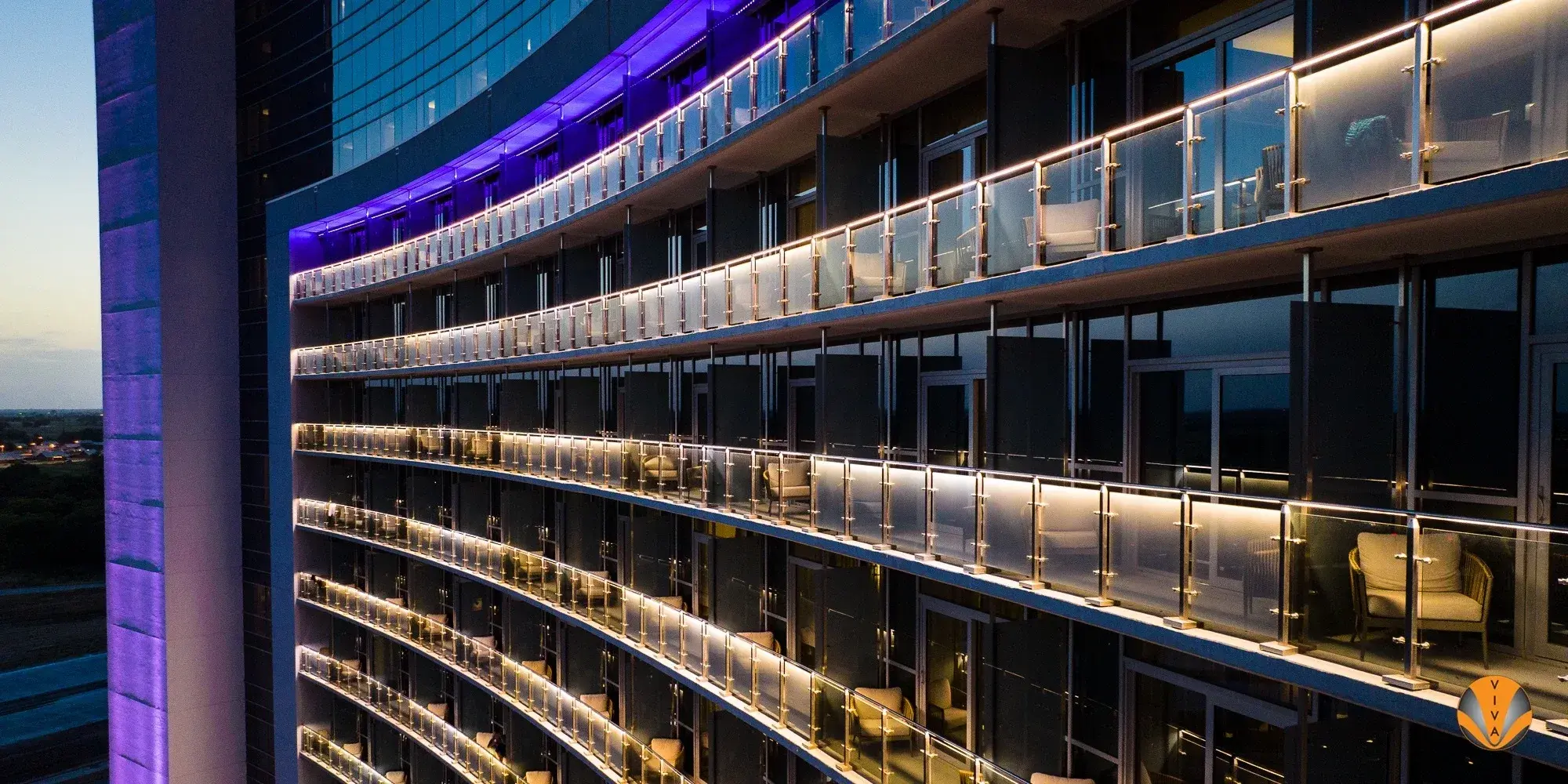
At Choctaw Casino & Resort, iRAIL Linear delivers ambient lighting through the handrail itself. This is the kind of specification that turns the railing into part of the hospitality experience rather than a background hardware element. In a casino environment where overhead lighting is intentionally low to preserve atmosphere, integrated handrail lighting keeps every path of travel safely illuminated without competing with the design intent of the space. General Contractor: TEPCO Glass. Architect: JCJ Architecture.
McGrath Amphitheatre — Cedar Rapids, IA
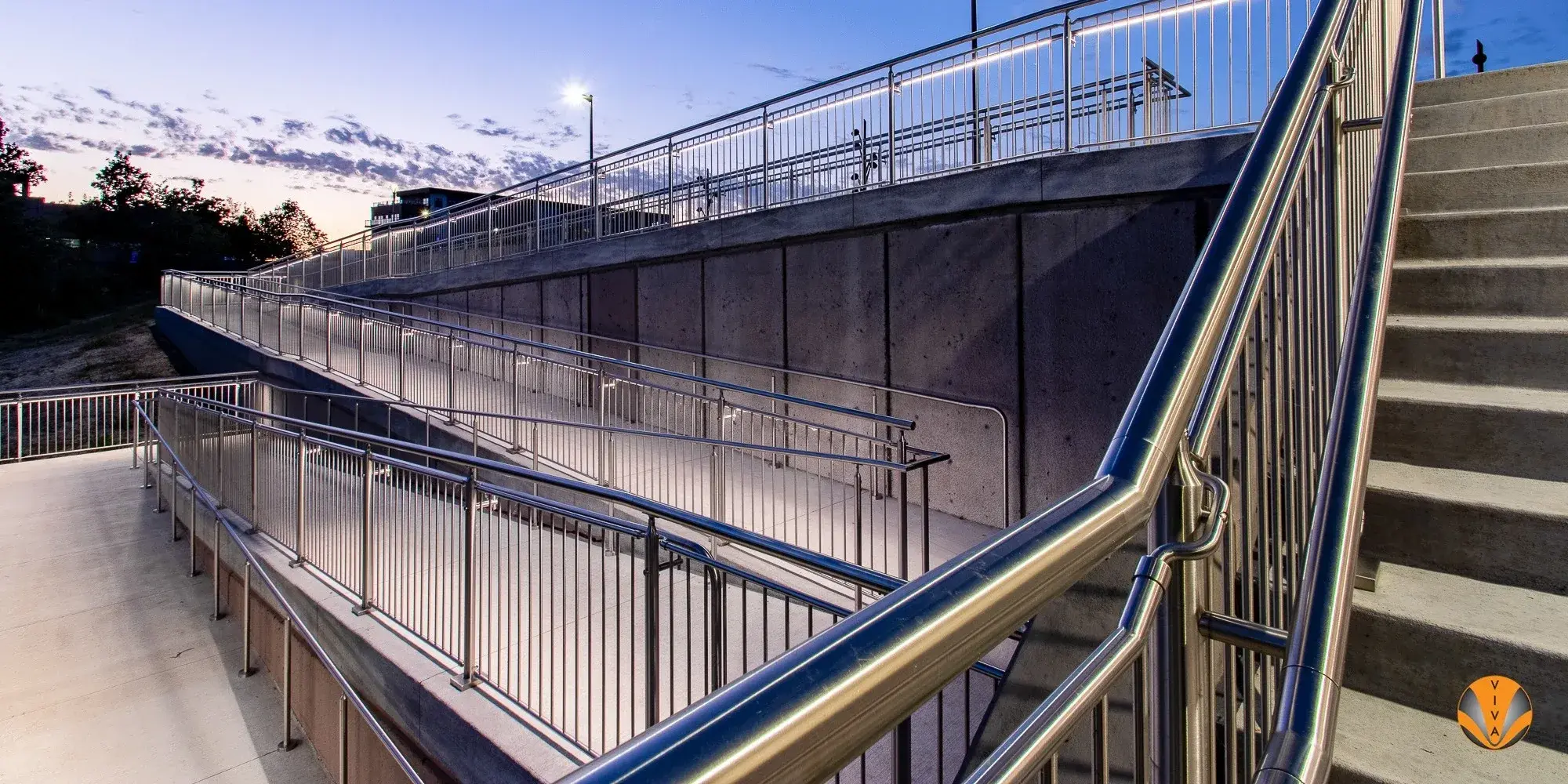
The McGrath Amphitheatre in Cedar Rapids, Iowa uses iRAIL Linear along venue tiers where guests move between seating levels during events. Amphitheaters and outdoor concert venues face a specific lighting challenge: ambient light has to stay low so the stage reads well, but audience circulation still needs to be safe. Integrated handrail LED solves this cleanly. General Contractor: Justice Electric.
Granite Park VI — Plano, TX
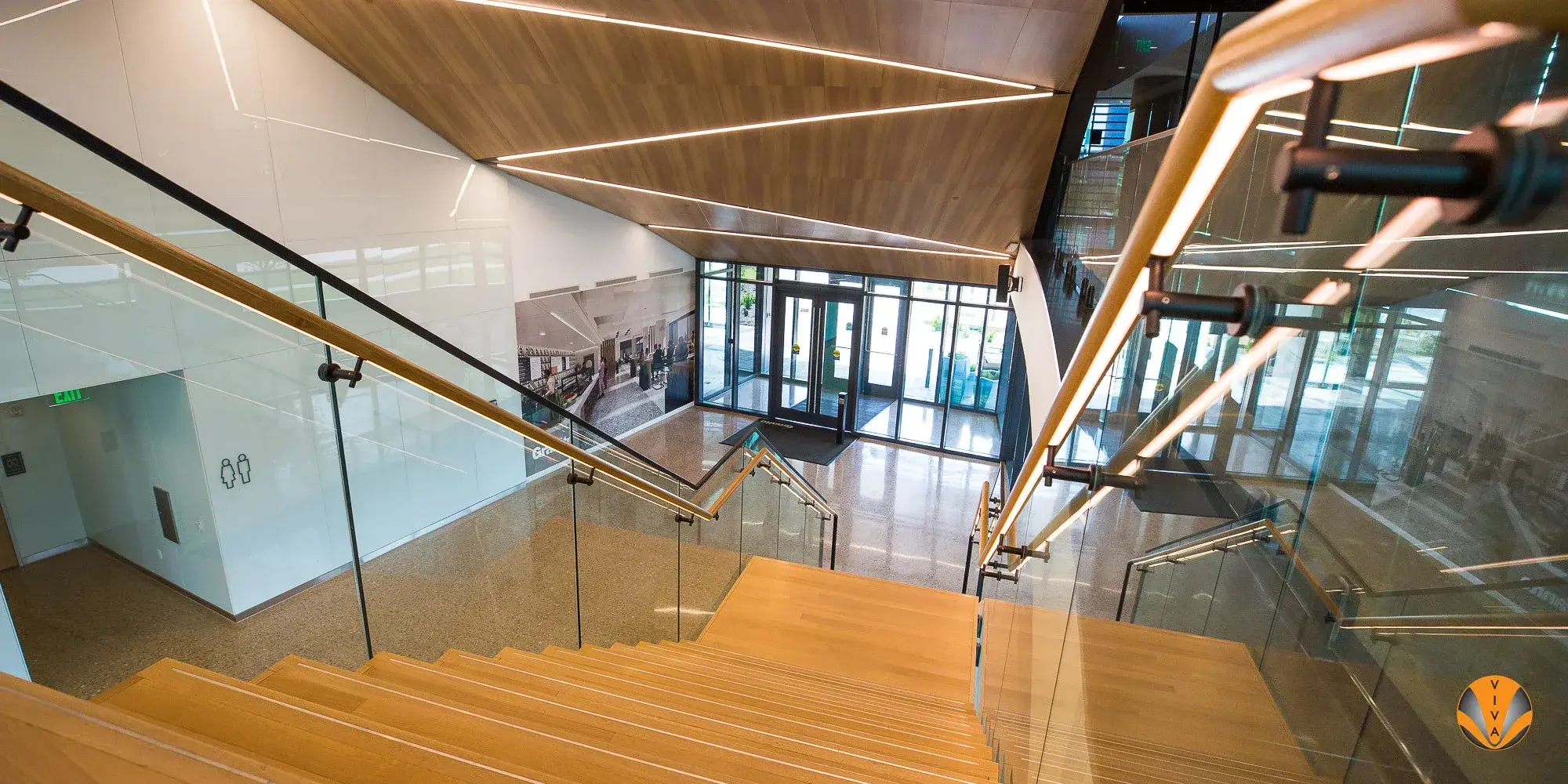
Granite Park VI in Plano, Texas is a corporate office project where iRAIL Linear provides continuous illumination along commercial railings. This is a good example of integrated lighting used in a corporate context: subtle, refined, code-compliant, and contributing to the premium design language of a Class A office environment. General Contractor: Austin Comm. Architect: BOKA Powell.
VIVA iRAIL LED System Options at a Glance
VIVA offers three iRAIL LED configurations designed for different lighting needs. The right choice depends on the application, the desired lighting effect, and the design language of the space.
iRAIL Linear is the continuous-illumination option. A specially designed LED runs the full length of the rail, delivering uninterrupted light across any rail run without preset section limits. Available in warm or bright white with clear or diffused lens options. The 1.5-inch ADA-compliant roll-formed rail houses the LED assembly seamlessly.
iRAIL Pods deliver point-source illumination through recessed LED modules housed in the stainless steel handrail. Pods can be spaced from 18 to 36 inches on center depending on the desired illumination effect. This is a strong specification for retrofits, spaces where continuous illumination isn't needed, and applications where the pod pattern itself contributes to the design.
iRAIL Sconce is a compact accent illumination fixture integrated into VIVA railing systems. It works well as a supplementary lighting element in spaces where the primary illumination comes from Linear or Pods but additional targeted light is needed at specific locations.
For a deeper technical comparison of the three systems including lens options, orientation choices, and specification detail, see the Commercial Illuminated Stair Railing Buyer's Guide.
Guiding People Through Space With Light
Integrated railing lighting is one of the few architectural elements that does safety, wayfinding, code compliance, and design language in a single specification. When it's done well, guests don't consciously notice it. They just move through the space with confidence, find the exit intuitively during an emergency, and experience the venue exactly as the architect intended.
VIVA has delivered iRAIL LED integrations on hospitality, entertainment, corporate, and civic venue projects across the country. Every engagement combines VIVA's core railing systems with iRAIL Linear, iRAIL Pods, or iRAIL Sconce integration based on the specific lighting and wayfinding needs of the project. The Design Assist Services page covers what early-stage manufacturer engagement looks like on integrated lighting projects.
Request a Quote or Talk to our Sales Team to work through your project.
Frequently Asked Questions About Integrated Railing Lighting
Do LED handrails count toward NFPA egress lighting requirements?
Continuous low-level path-of-egress lighting is permitted and encouraged under NFPA 101 (Life Safety Code) in assembly occupancies. Integrated handrail LED systems can contribute to the egress lighting strategy, though they're typically specified as part of a broader egress lighting design rather than the sole solution. Local codes may have specific requirements; verify with the AHJ during design development.
Can iRAIL LED systems be dimmed or programmed?
Yes. iRAIL LED systems run on low voltage DC power and can be integrated with commercial dimming and control systems. This allows the lighting to adjust to time of day, occupancy, event conditions, or building automation controls. In theater and hospitality applications especially, dimmable integration is often part of the specification.
Do iRAIL LED handrails meet ADA requirements?
Yes. The iRAIL Linear system uses an ADA-compliant 1.5-inch roll-formed rail that meets Section 505 ADA handrail requirements for cross section, graspability, and continuity. The LED integration does not affect ADA compliance.
How do integrated LED handrails compare to traditional overhead lighting for wayfinding?
They serve complementary functions. Overhead lighting provides ambient illumination for tasks and general visibility. Integrated handrail lighting specifically supports path-of-travel navigation at the height users' hands and eyes naturally reference. The two together deliver both general illumination and directional wayfinding, and in emergency conditions when overhead lighting may be compromised, the handrail lighting provides the continuous line of sight that leads to safety.