Once a project commits to a railing system, the next decision drives almost everything visible about it: what fills the space between the posts. Cable, glass, and perforated metal are the three infill categories that dominate commercial work today, and they solve fundamentally different design problems.
Cable disappears visually. Glass holds the line aesthetically without obstructing it. Perforated metal turns the railing itself into pattern and texture. None of them is universally better. The question is which one matches the design intent, the budget, the environment, and the way the space is meant to feel.
Here's a real comparison of cable, glass, and perforated metal infills, with project examples from VIVA's portfolio showing how each one performs in commercial practice.
How the Three Infills Actually Differ
Cable infill uses tensioned stainless steel cables running horizontally between posts. The visual impression is minimal: a few thin lines breaking up the view, but most of the field stays open. From across a room, cable nearly disappears.
Glass infill uses laminated or tempered safety glass panels between posts (or anchored continuously in structural glass systems). The visual impression is transparent. Sightlines are uninterrupted, but the full plane of the railing reads as a continuous surface.
Perforated metal infill uses panels of aluminum or stainless steel with patterned holes, slots, or shapes cut through the surface. The visual impression is textural: pattern, shadow, and depth across the panel face. Perforated reads as both a guard and a design element in its own right.
That's the headline difference. Underneath it sit a series of practical trade-offs that drive the actual specification.
The Three Infills Compared
| Cable | Glass | Perforated Metal | |
|---|---|---|---|
| Visual character | Minimal, near-transparent linear lines | Fully transparent, frameless or post-supported | Textural pattern, design element |
| Sightline impact | Almost none | None to private, dependent on opacity | Partial; pattern dependent |
| Privacy/screening | None | None (unless frosted, tinted, or printed) | Variable; depends on perforation density |
| Maintenance | Periodic retensioning; cleaning | Routine cleaning; panel replacement if damaged | Routine cleaning; durable, low maintenance |
| Code compliance | IBC sphere rule (4" max) requires careful cable spacing | Laminated safety glass + structural performance | Pattern selected to meet IBC 4" sphere rule |
| Typical cost | Low to mid | Mid to high | Mid |
| Best for | Exterior balconies, decks, view-first design, retail | Lobbies, hospitality, premium commercial, frameless aesthetic | Multi-family, K-12, mixed-use, design-forward commercial |
| VIVA systems | CIRCA Cable, BLADE, BEACON | SHOE, VIEW, CIRCA Glass, BEACON Glass, VISIO | BEACON, VISIO, BLADE Air with laser-cut panels |
The previous article on choosing a railing system walks through the broader four-factor decision (occupancy, budget, aesthetics, schedule). This piece goes deeper on the infill-specific question once the system framework is set.
Cable Infill: When Visibility Is the Brief

https://vivarailings.com/products/circa-stainless-steel-cable-railing
Cable infill works when the design intent is to barely see the railing at all. It's the right answer for projects where the view through the railing matters more than the railing itself: balconies overlooking a feature space, stair landings opening to a double-height lobby, exterior decks looking out over a streetscape or view shed.
What you get:
Maximum sightline preservation. A clean, minimal aesthetic that defers to the surrounding design. Low material cost relative to glass. Excellent performance in exterior applications when specified in 316 stainless. Easy integration with stainless steel posts in CIRCA, BLADE, and BEACON systems.
What you plan for:
Code compliance requires careful cable spacing. The IBC's 4-inch sphere rule (no opening in a guard can pass a 4-inch sphere through it) means cable runs typically need to be spaced at roughly 3 inches on center, sometimes tighter on staircase applications where the angled cable rises. Cables also need periodic retensioning to maintain appearance and performance, typically once every several years. In coastal environments, 316 stainless is the right grade.
Featured Project: Publix #0621 "On the Bay" — Miami, FL

https://vivarailings.com/projects/cable-stair-railing-publix-0621
Product: CIRCA Cable Railing System Architect: Fisher and Associates, LLC General Contractor: Oak Construction Linear footage: Over 300 LF of CIRCA Cable Railing
This Miami retail location uses VIVA's CIRCA Cable system for over 300 linear feet of stair and balcony work. The site is a coastal grocery store, which means cable infill needed to handle exterior chloride exposure, deliver the minimal-visual-interruption aesthetic the architect wanted, and stay maintainable for a high-traffic retail environment. Cable was the right call because it preserves the open feel of the space while still meeting commercial guard load requirements.
Glass Infill: When the Line Needs to Read Continuously

https://vivarailings.com/products/circa-glass-railing-system
Glass infill is the answer when the design wants visual transparency across the full plane of the railing rather than a series of horizontal lines. It's the dominant choice in hospitality, premium corporate, airports, healthcare, and any space where the railing should read as a frameless plane that doesn't compete with the surrounding architecture.
What you get:
Fully transparent or selectively patterned visual character. The widest range of design expression: clear, colored interlayer, tinted, gradient pattern, frosted, or digitally printed glass for branding or feature work. Code-compliant safety performance when properly specified with laminated glass and the right interlayer (PVB for interior, SGP for high-performance and exterior). Compatibility across multiple VIVA systems, from structural glass like SHOE and VIEW to post-supported glass like CIRCA Glass, BEACON Glass, and VISIO.
What you plan for:
Higher first cost than cable or perforated metal. Heavier components requiring engineered substrate support, especially in structural glass applications. Cleaning protocol is straightforward but visible smudges and fingerprints show up in high-touch areas. Glass replacement is straightforward in modular systems like SHOE (roughly 30 minutes with an Allen wrench) but varies on post-supported clamp/clip systems.
Featured Project: Andretti Indoor Karting & Games — Fort Worth, TX

https://vivarailings.com/projects/glass-led-railing-andretti-ft-worth
Product: CIRCA Glass Railing System with iRAIL Linear LED handrail Architect: 5G Studio General Contractor: Parkway Construction & Architecture
Andretti's Fort Worth location uses VIVA's CIRCA Glass system with integrated iRAIL Linear LED illuminated handrails. The entertainment-venue context calls for visual energy and an experiential feel; glass infill keeps sightlines open to the racing simulators, arcade floor, and bowling, while the iRAIL Linear adds the architectural light element. Glass was the right call because it lets the space's activity be the visual focus while the railing itself reads as a clean, integrated element.
Featured Project: Sherman ISD New High School — Sherman, TX
https://vivarailings.com/projects/sherman-isd-new-high-school
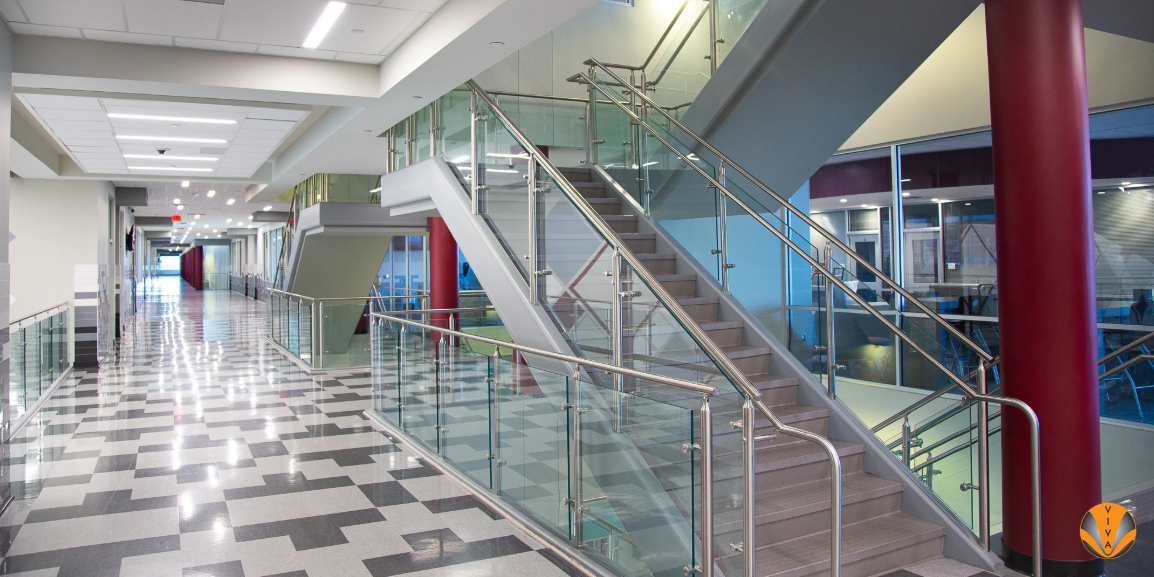
Product: Glass Railing System (per project page) Sector: K-12 Education
The new Sherman High School uses glass railings to bring transparency and a modern aesthetic into the educational environment. K-12 work increasingly favors glass infill on main corridors, atriums, and mezzanines because it opens sightlines for supervision while delivering the contemporary aesthetic owners now expect on new builds. Glass was the right call because it serves both the design intent and the practical sightline requirements of a school environment.
Perforated Metal Infill: When the Railing Should Be a Design Element

https://vivarailings.com/perf-metal
Perforated metal turns the railing from a transparent or near-transparent guard into an active design element. Pattern, shadow, and depth become part of the visual experience. Specifiers reach for perforated when the railing is supposed to contribute to the architecture rather than disappear into it.
What you get:
Pattern variety: primary, geometric, and organic patterns across VIVA's perforated metal and laser-cut panel offerings. Adjustable transparency depending on perforation density. Strong performance in high-use environments where cable or glass might be vulnerable to abuse. Compatibility with VIVA post systems including BEACON, VISIO, and BLADE Air. Capacity to be specified in stainless, aluminum, or finished steel depending on environment and aesthetic.
What you plan for:
Perforation pattern needs to be selected to meet code (the IBC 4-inch sphere rule still applies, which limits the larger-opening patterns in certain contexts). Sightlines are partial rather than continuous, which is a feature, not a bug, when the design wants visual interest, but a constraint when the project wants pure transparency. Maintenance is generally low, but cleaning the pattern itself takes more time than a smooth surface in dusty or high-debris environments.
Featured Project: Sampson High School — Perforated Metal with BEACON System

https://vivarailings.com/projects/perf-metal-beacon-sampson
Product: BEACON Railing System with perforated metal infill Sector: K-12 Education
This K-12 application uses VIVA's BEACON post system with perforated metal infill. School environments often need a balance between sightline (for supervision) and physical durability (the railing will see daily contact from students), and perforated metal handles both well. The patterned aesthetic also gives the space a designed quality that elevates the corridor or stair beyond a generic institutional guard.
Featured Project: Strickland Middle School — Contemporary Perforated Railing
https://vivarailings.com/projects/contemporary-railing-strickland-ms
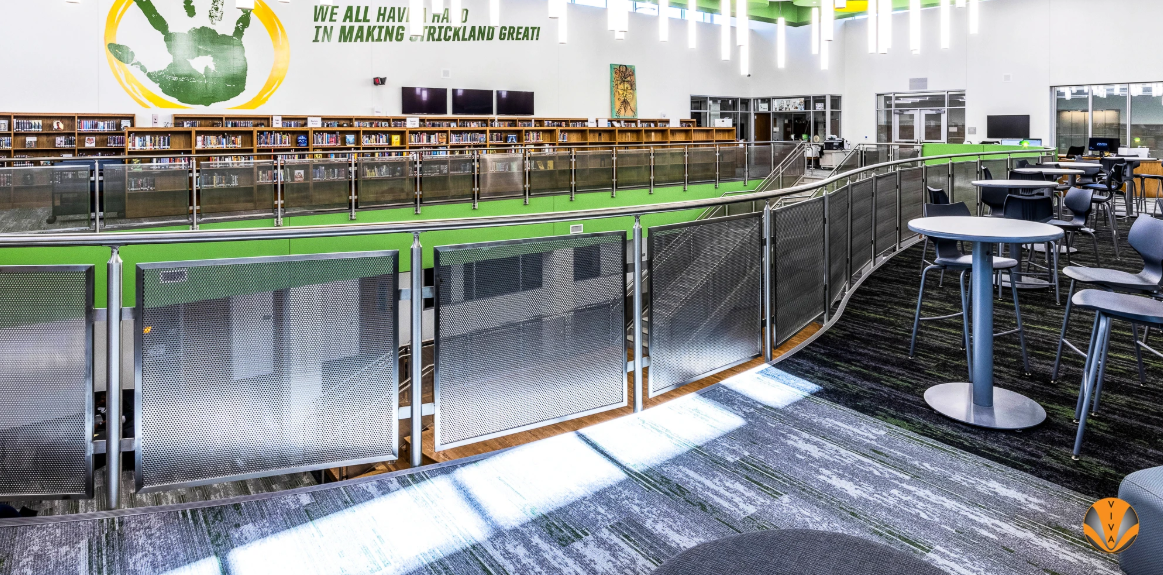
Product: Perforated metal infill (per project page) Sector: K-12 Education
Strickland Middle School uses perforated metal infill to deliver a contemporary aesthetic in a public school setting. The design intent was a modern look that still met the durability and code requirements of K-12 work. Perforated metal lets the school have a designed, custom feel without the cost or maintenance considerations of a fully glass solution.
How to Decide Between Cable, Glass, and Perforated
Three questions cut through most of the analysis quickly.
1. What is the railing supposed to do visually? If the answer is "disappear," cable wins. If the answer is "be transparent but read as a continuous plane," glass wins. If the answer is "be part of the architectural expression," perforated wins. Most projects can articulate which of these three the design intent calls for in one sentence.
2. What's the environment and traffic level? Exterior coastal with view priority leans cable (in 316 stainless). Premium interior with high-touch handrails and design-forward owners leans glass. High-use K-12, multi-family corridors, and design-forward commercial lean perforated. Environment and use case narrow the field fast.
3. What does the budget actually support? Cable is typically lowest first cost. Perforated sits in the middle. Glass (especially structural glass) is the highest. Lifecycle math can change this ranking, but install-day budget is real and protecting the right infill choice from value-engineering matters.
For projects that can't pick one, mixing is normal. Hospitality projects often use glass in primary lobbies and cable on exterior decks. K-12 work often combines perforated on corridors with glass on signature stairs. The right answer for a complex project is usually a combination.
Talk Through Your Project
The right infill choice isn't always obvious from the design narrative alone. Substrate, environment, sightline priorities, traffic, and budget all weigh in. VIVA's pre-construction team works through this decision with architects, GCs, and owners on a project-by-project basis to land on the right combination of post system, infill, and finish.
The Design Assist Services page covers what early-stage manufacturer engagement looks like.
Request a Quote or Talk to our Sales Team to work through your project.
Frequently Asked Questions
Can I mix infill types on the same project?
Yes, and it's common. Many projects use glass in high-design areas, cable in exterior or view-first applications, and perforated in corridors or back-of-house spaces. VIVA's post systems (CIRCA, BEACON, VISIO, BLADE) accept multiple infill types within the same product family, which simplifies the spec coordination.
Which infill is the most affordable?
Cable is typically the lowest first cost. Perforated is mid-range. Glass is the highest, with structural glass at the top of the range. Total cost of ownership math sometimes shifts the ranking, especially when finish quality and replaceability are factored in.
Which is the lowest maintenance?
All three are relatively low maintenance in their intended environments. Cable needs periodic retensioning (typically once every several years). Glass needs routine cleaning. Perforated needs routine cleaning, with attention to the pattern in dusty environments. None of the three requires significant ongoing investment if specified correctly.
What about code compliance across the three?
All three can meet IBC requirements when properly specified. Cable requires careful spacing to meet the 4-inch sphere rule. Glass requires laminated construction and proper engineering for guard loads. Perforated requires pattern selection that meets the sphere rule. None of the three is inherently easier or harder to code-comply; it's a function of how it's specified.
Can the design change after specification?
On modular pre-engineered systems, infill can often be swapped down the road without replacing the underlying post framework. That's one of the advantages of VIVA's post-supported product family. Custom-fabricated systems are harder to modify after install.