


Glass railing is one of those terms that gets used to cover a lot of different systems, and the distinction matters more than most people realize. When an architect specifies "glass railings" for a project, the GC, the engineer, and the owner might all be picturing something different. One's thinking frameless. One's thinking of glass panels between metal posts. One's thinking cost.
The real dividing line in glass railings is structural vs. post-supported, and it changes almost everything about how the system performs, how it looks, how much it costs, and how it gets installed.
Here's how to tell them apart and how to figure out which one is right for what you're building.
The Core Difference in One Sentence
In a structural glass railing, the glass itself is the structure. It carries the load.
In a post-supported glass railing, metal posts carry the load, and the glass is infill between them.
Everything else flows from that.
Structural Glass Railings
Structural glass systems use the glass panel as the load-bearing element of the balustrade. There are no vertical posts breaking up the run. The glass is anchored either into a continuous base shoe at the floor or at discrete points along its edge, and from there it carries the guard loads, handrail loads, and any wind loads the code requires.
You've seen this look on high-end hospitality projects, airport concourses, stadium suites, corporate lobbies, and almost any space where the design intent is "get out of the way of the view." When a project calls for an uninterrupted sightline, structural glass is almost always the answer.
What you get with structural glass:
Unobstructed sightlines with no post pattern breaking up the visual field. A more modern, minimalist aesthetic. The option to run a slim top cap or, on certain systems like VIEW, no top rail at all. Fewer components to finish, paint, or maintain.
What you have to plan for:
Structural glass demands heavier glass. Typically 1/2" or 5/8" minimum laminated glass, with the exact thickness driven by guard height, wind load, and spans. That means more weight per linear foot, which means the supporting substrate has to be engineered to accept it. You can't retrofit a structural glass railing onto a substructure that wasn't designed for the load transfer.
Installation is also more precise. The anchoring hardware, base shoe, or button connections have to land in exact positions, and the glass has to be set level within tight tolerances. This is where a manufacturer with in-house engineering and a dedicated install crew saves a schedule. Field conditions and hold-to dimensions matter here more than almost any other railing type.
Where VIVA fits:
The SHOE Structural Glass Railing System uses a patented continuous-compression aluminum base shoe (US Patent No. 9127474) that anchors the glass along its entire edge, with positive water drainage and an ICC-ES evaluation report (ESR-4405) covering IBC, IRC, California, and Florida wind-borne debris regions.
The VIEW Structural Glass Balustrade System takes a different approach using button-style point holders, typically fascia mounted. It's the right call when the goal is to show off the glass edge and keep the floor plane completely clean, without any base shoe reading at the slab.
Both sit in VIVA's Glass Systems catalog under the structural glass category.
Post-Supported Glass Railings
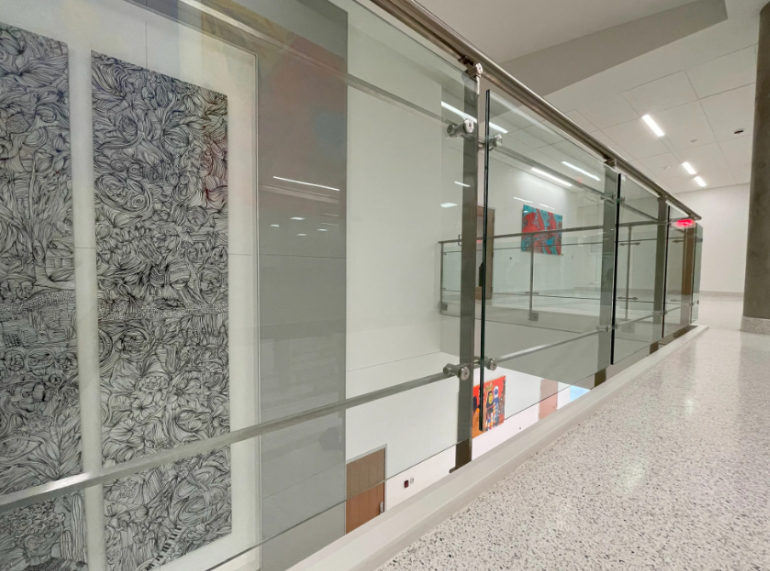
Post-supported systems flip the engineering. Here, metal posts (typically stainless steel or aluminum, sometimes powder-coated) carry the structural load. The glass panels sit between them as infill, attached with clips, clamps, or captured within the post profile itself.
This is the approach you see on a huge volume of commercial work: hotels, multi-family balconies, K-12 and university mezzanines, restaurants, retail, corporate interiors. It doesn't have the frameless "wow" of a structural system, but it's more forgiving, more flexible, and almost always more cost-effective.
What you get with post-supported glass:
Significantly lower cost per linear foot. Lighter glass (typically 3/8" or 1/2" tempered or laminated, depending on the spec). A system that's easier to install in the field because the posts do the structural work and absorb more tolerance variation. Flexibility to mix glass with other infills across a project, or to change infill down the road without replacing the framing.
What you trade off:
The post pattern. No matter how thin you make the posts, they read as a rhythm in the space, and that's either the look you want or a compromise you're making. On stair runs and long balcony runs, the pattern can be elegant. On a wide-open lobby guardrail, it can feel busier than what structural glass would deliver.
Where VIVA fits:
VIVA's post-supported glass family includes BEACON Glass, VISIO, CIRCA Glass, CUBE Glass, BLADE, BLADE Air, and FIN for interior applications. Each handles glass infill a little differently. VISIO, for example, uses glass clips rather than capturing the glass in the post profile, which gives it a cleaner post-to-glass junction while keeping the structural load on the post.
The Side-By-Side
If you strip it down to the decisions that actually drive specification, here's the honest comparison.
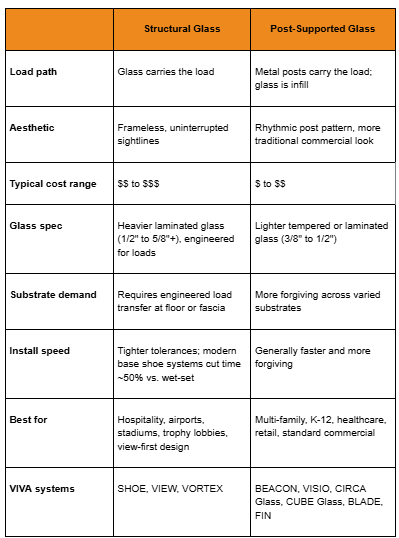
A few things worth calling out beyond what the table shows.
Both paths can meet IBC. ICC-ES evaluation reports are more commonly attached to structural systems because they're the ones most scrutinized on plan review, but that doesn't mean post-supported systems are less code-compliant. It means the documentation path is different.
On maintenance, structural glass has fewer metal components to refinish, but post-supported systems often make individual glass panel replacement easier because you're swapping infill rather than demoing a load-bearing element.
And on schedule, lead times are driven more by finish selection, glass spec, and field-measured hold-to dimensions than by whether the system is structural or post-supported. A structural glass system on a straight run with a steel substrate can move faster than a post-supported system waiting on a custom powder coat.
How to Actually Decide
The short answer: start with what the design is trying to accomplish, not with what's cheapest.
If the project's driving goal is an uninterrupted view, frameless appearance, or a specific architectural expression where posts would undermine the intent, structural glass is worth the cost delta. This is common in hospitality, high-end corporate, airports, stadiums, and trophy-level institutional work.
If the project needs cost-effective safety infill with a clean modern look, and the post pattern works with (or doesn't compete with) the design, post-supported glass is almost always the better spend. This covers most multi-family, K-12, healthcare, retail, and standard commercial interiors.
Two questions that sharpen the decision quickly:
- Can the substructure handle the load transfer of structural glass? If the slab or edge condition wasn't designed for it, retrofitting gets expensive fast. Post-supported glass is more forgiving on varied substrates.
- Does the budget include a real structural glass allowance, or is "frameless glass" a wish that's going to get value-engineered out at 60% CDs? If it's the latter, commit to post-supported early and pick a system whose posts you actually like, instead of ending up with a compromise neither camp is happy with.
If you're still weighing the decision, Top 4 Considerations in Choosing a Railing System walks through occupancy, budget, aesthetics, and schedule. And if you're trying to think through the mounting method independent of the infill, Railing Mounts 101 covers fascia, top, core, and shoe mounts in detail.
Talk Through Your Project
The right call between structural and post-supported glass comes down to design intent, budget, substructure, and schedule. That's a conversation, not a checklist.
VIVA's pre-construction team works with architects, GCs, and owners to spec the right system before the decision gets locked in, and the company's Design Assist Services exist specifically for this phase of the project.
Request a Quote or Talk to our Sales Team to work through your specific project.
Frequently Asked Questions
Is structural glass stronger than post-supported glass? It's not really a question of strength. Both systems are engineered to meet the same code loads. The difference is how the load is carried. Structural glass transfers loads through the glass itself; post-supported transfers them through metal posts. Both are safe when properly specified and installed.
Can you have structural glass without a top rail? Yes, on some systems. Code allows no top rail in certain conditions if the glass is laminated with a compliant interlayer and the system is evaluated for that configuration. VIVA's VIEW system is designed for this application. Always verify with your local jurisdiction.
Which is faster to install? Post-supported glass is generally faster because posts absorb more field tolerance. But within structural systems, a well-engineered base shoe system like SHOE can install roughly 50% faster than traditional wet-set structural glass.
Do I have to pick one for the whole project? No. It's common to mix systems across a project, using structural glass in high-visibility areas (lobby, main stair, premium hospitality spaces) and post-supported glass in back-of-house, secondary stairs, or multi-family balconies where budget matters more than frameless aesthetics.