Coastal projects are the hardest environment a commercial railing system will ever see. Salt-laden air, persistent humidity, UV exposure, and chloride deposition combine into a chemical attack that's slower than a hurricane but more reliable. The wrong material or finish spec is usually invisible on installation day. It shows up two or three years later as rust bleed at fasteners, pitting on post bases, and a maintenance line item nobody budgeted for.
The good news is that coastal-grade railings aren't a mystery. The material science is settled, the failure modes are well documented, and the right specification holds up for decades. The bad news is that "coastal" gets used loosely enough in product literature that two systems labeled the same way can perform completely differently in the field.
Here's what actually drives corrosion resistance in commercial railing systems, what to spec, and what to plan for in maintenance.
This is the conversation VIVA has with architects and GCs on every coastal project. Twenty years of fabricating commercial architectural railings across Florida, the Gulf Coast, California, and oceanfront markets means the material decisions below aren't theoretical. They're the specifications that have held up in the field, and the ones that haven't.
What's Actually Attacking Your Railing
Coastal corrosion isn't one thing. It's three overlapping mechanisms.
Chloride Attack on the Passive Layer
Stainless steel resists corrosion because of a thin chromium oxide film that forms on the surface. Chloride ions, which are abundant in marine aerosols, penetrate that layer and create localized pitting. Once pitting starts, it accelerates because the affected area becomes an electrochemical cell with the surrounding healthy metal.
Crevice Corrosion
Anywhere two surfaces meet (fastener heads against post bases, glass clips against railing tops, post sleeves at base plates) creates a confined space where chloride concentration builds up. Crevice corrosion runs faster than open-surface pitting because the trapped solution can't dilute itself with rain or wind.
Galvanic Corrosion at Dissimilar Metals
When two different metals contact each other in the presence of a salt-laden electrolyte (rainwater on a coastal balcony, for instance), the less noble metal corrodes preferentially to protect the more noble one. A carbon steel anchor in a stainless post becomes a sacrificial anode whether you intended it to or not.
ISO 9223 classifies atmospheric corrosivity into categories C1 through CX. Coastal sites within roughly a mile of seawater fall into C5 (very high). Sites within one to six miles fall into C4 (high). The U.S. Department of Defense's UFC 1-200-01 specifies these same thresholds for design purposes. If you're specifying a railing within that range, you're in the most aggressive non-industrial atmospheric environment your project will encounter, and the material selection has to reflect that.
The Material Decisions That Drive Performance
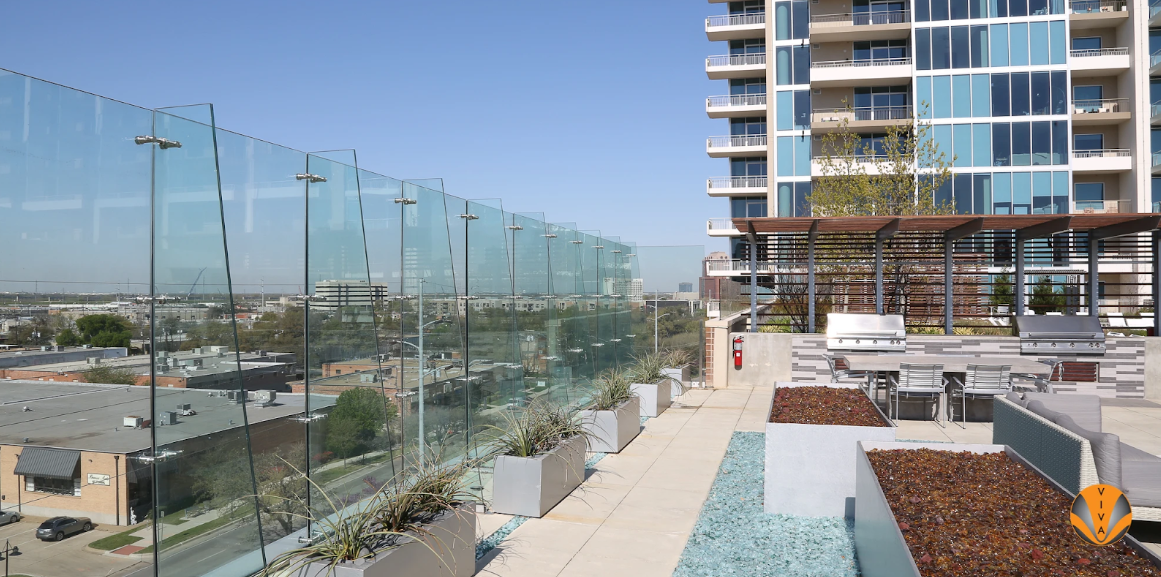
Three material conversations dominate coastal specification.
304 vs. 316 vs. 316L Stainless Steel
The most common mistake in commercial coastal work is specifying 304 stainless and assuming it'll perform. It won't, at least not for long.
304 stainless (also called 18-8) contains roughly 18% chromium and 8% nickel. It performs well in most architectural environments, including freshwater, urban, and rural settings. In chloride-rich coastal air, it pits. Pitting on 304 in C5 environments shows up within months, not years.
316 stainless adds 2-3% molybdenum to the alloy, which substantially improves resistance to chloride pitting and crevice corrosion. This is the baseline material for coastal commercial work. Specifying anything less for direct salt air exposure is a known mistake.
316L stainless is 316 with lower carbon content. The L matters because welded joints in standard 316 can become sensitized (carbide precipitation at grain boundaries) and corrode preferentially. For railing systems with site welding or significant shop welding at coastal applications, 316L is the safer call.
VIVA fabricates in 304, 316, and 316L stainless across its product line and specifies the grade by exposure category. For C5 coastal work, 316L is the standard recommendation on systems with welded joints, including stainless multiline platforms like CIRCA Multiline and stainless modular systems like BLADE. Standard "stainless" is not a coastal spec. Grade callouts matter.
Aluminum in Coastal Applications
Marine-grade aluminum alloys (5052, 5083, 6061-T6) actually perform very well in coastal environments because aluminum forms its own protective oxide layer. The catch is two-fold.
First, aluminum is softer than stainless steel, which means handrails and high-touch surfaces show wear faster. Second, and more importantly, aluminum cannot touch dissimilar metals in coastal exposure without isolation. An aluminum post anchored with stainless hardware in a salt-spray environment will corrode at the contact point through galvanic action.
Where aluminum makes sense in coastal commercial work is in glass railing base shoes, where the load path is contained and the aluminum can be anodized or finish-coated. VIVA's SHOE Structural Glass Railing System uses an aluminum base shoe specifically for this reason, with positive water drainage engineered into the profile so chloride solution can't pool at the glass-to-shoe interface. SHOE carries ICC-ES evaluation report ESR-4405 with explicit coverage for Florida's wind-borne debris regions and the High-Velocity Hurricane Zone, which is the most demanding code environment for coastal glass railing work in the United States.
Powder-Coated Steel and Carbon Steel
Carbon steel is the wrong material for direct coastal exposure, full stop. Powder coating helps but only as long as the coating is intact. Any breach (an impact scratch, a drilled hole at a field-modified post, a chip from concrete cleaning) becomes a corrosion initiation site that propagates underneath the coating. By the time you see rust, the substrate is compromised.
Powder-coated steel can work for inland projects within the coastal zone (C4 environments more than three miles from open water) if the coating is specified correctly (AAMA 2605 PVDF rather than AAMA 2604 polyester) and the substrate is properly prepared. For direct salt-air exposure, stainless or aluminum is the right choice.
The Hidden Killer: Galvanic Corrosion at Connections
Even with the right base material, coastal railings fail at junctions. Here's where most specs go wrong:
- Mixed-grade fasteners. A 316 stainless railing assembled with 304 fasteners will see the fasteners corrode preferentially. Specify the fastener grade explicitly, not "stainless."
- Carbon steel anchors in stainless posts. Anchor selection at the substrate matters as much as the post material. Stainless or hot-dip galvanized anchors with isolation are the minimum standard for coastal work.
- Aluminum-to-stainless contact without isolation. Where it's unavoidable, use nylon isolation bushings, fluoropolymer-coated hardware, or insulating washers. Don't assume "they're both corrosion-resistant on their own" means they're compatible.
- Dissimilar metal contact at glass clips and clamps. Glass railing systems with mixed-metal clamping hardware require the same isolation discipline as post-to-anchor connections.
This is the layer of specification that's almost always missed by specifiers focused on the visible system. The visible posts and panels matter, but the connection details are where coastal installations fail first.
VIVA's pre-construction and engineering team catches these connection issues during shop drawing review, not in the field. The material schedule, fastener grade, anchor type, and isolation details are confirmed before fabrication releases. That process is the reason VIVA installations in coastal markets hold up the way they do, and it's the single biggest argument for involving a manufacturer with in-house engineering on a coastal project rather than buying a railing as a commodity.
Finishes That Actually Hold Up
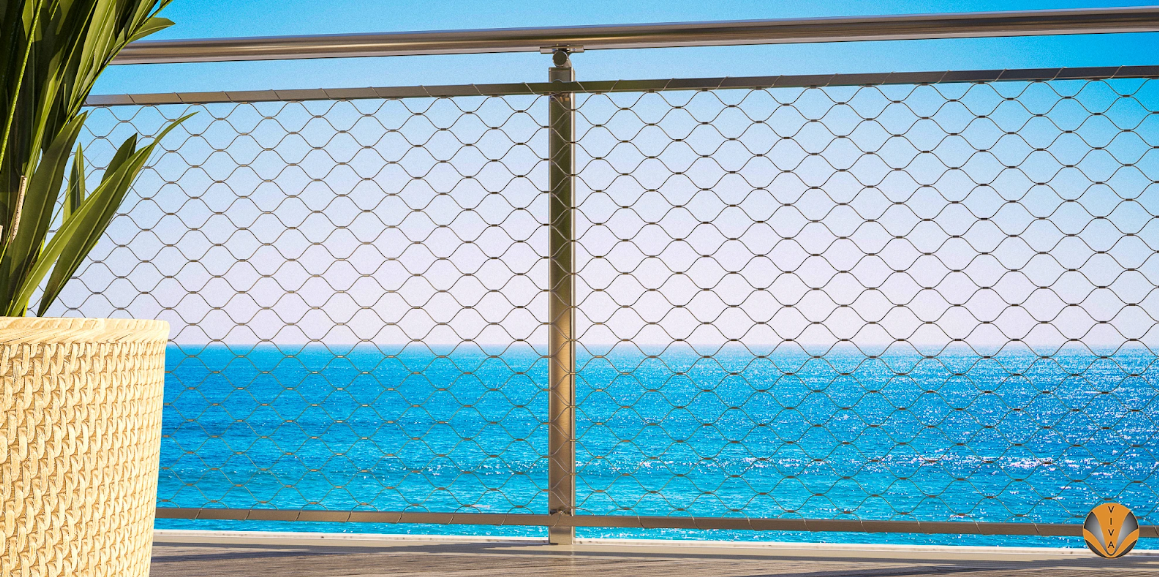
For exposed stainless, satin finishes (#4 or #6) generally outperform mirror finishes in coastal applications because the slightly textured surface drains better and shows less visible pitting in early stages. Mirror finishes look spectacular on day one but every micro-pit reads as a defect against the polished background. VIVA specifies #6 satin as the default for coastal stainless work, with #8 mirror available where the design calls for it and the maintenance commitment supports it.
For aluminum and any coated components, finish selection becomes more critical. VIVA offers three finish paths for coastal applications:
CeraShield, VIVA's proprietary Cerakote-powered finish, is the differentiated option. CeraShield is engineered specifically for exterior-grade performance with superior scratch resistance, fade resistance, and chemical durability compared to standard powder coats. It applies to both stainless and aluminum substrates, comes in 25-plus standard colors including metallics, and holds up in environments where conventional powder coats degrade. This is the finish VIVA specifies on coastal work where the design calls for color flexibility without giving up performance.
PVDF powder coat (AAMA 2605) offers excellent color retention and corrosion resistance among industry-standard powder coats. PVDF is the right call for any powder-coated component in a coastal application, and VIVA fabricates with PVDF where projects specify it. This is the broader industry-standard finish, available across most manufacturers, and it performs.
Anodizing creates an integral oxide layer on aluminum components that's harder and more chemically stable than the natural oxide. Class I anodizing (0.7 mil minimum) is the spec for coastal use, and it's the right choice where the design calls for a clear or bronze anodized appearance rather than a colored finish.
The right finish doesn't replace the right base material. It extends the service life of the right base material. A finish over the wrong substrate will still fail where the substrate fails. The finish is the second line of defense, not the first.
What "Coastal-Grade" Actually Looks Like Spec'd Right
Pulling it all together, a coastal commercial railing specification at C4 or C5 exposure should include:
- 316 or 316L stainless steel for all structural posts, top rails, handrails, and visible hardware.
- PVDF (AAMA 2605) powder coat, anodizing, or CeraShield finish for any aluminum or coated components.
- 316 stainless fasteners throughout, with grade explicitly called out in the spec rather than left as "stainless."
- Stainless or hot-dip galvanized anchors with isolation at substrate connections.
- Nylon or fluoropolymer isolation at any unavoidable dissimilar-metal contact.
- Laminated glass with SGP interlayer (not PVB) for glass infill in high-humidity, high-UV coastal environments.
- A maintenance protocol included in the closeout documents, not assumed to be the owner's problem.
How VIVA Approaches Coastal Specifications
VIVA fabricates railings in both stainless and aluminum platforms, and the right call depends on exposure level, design intent, and budget. Here's how the two paths compare across the variables that actually drive coastal performance.
| 316 Stainless Steel Systems | Aluminum Systems with Coastal Finish | |
|---|---|---|
| Base material | 316 or 316L stainless throughout | Marine-grade aluminum (5052, 5083, 6061-T6) |
| Corrosion resistance mechanism | Chromium-molybdenum oxide layer resists chloride pitting | Natural aluminum oxide layer; enhanced by finish |
| Finish options | #6 satin standard; #8 mirror, CeraShield, or PVDF powder coat optional | CeraShield, PVDF powder coat (AAMA 2605), or anodizing |
| Typical VIVA systems | CIRCA Multiline, BLADE, BLADE Air, VISIO (stainless components), FSR | SHOE base shoe (aluminum), MetalSpaces components |
| Best for | Direct salt spray, oceanfront balconies, high-touch handrails | Set-back coastal, glass railing bases, mixed-exposure projects |
| Cost | Higher | Lower |
| Galvanic discipline required | Match fastener and anchor grade to 316 | Critical at any dissimilar-metal connection; isolation required |
| Maintenance cycle | Quarterly cleaning; passivation if early pitting found | Quarterly cleaning; touch-up of finish damage |
For C5 direct salt spray exposure (oceanfront balconies, beachfront commercial, marine-adjacent hospitality), 316 stainless is the conservative call and the spec VIVA typically recommends. Systems like CIRCA Multiline and BLADE are fabricated in 316L for coastal applications.
For C4 set-back coastal exposure (one to six miles from open water, with some natural breaks and reduced direct salt deposition), marine-grade aluminum with CeraShield or PVDF can perform comparably at a lower cost. The SHOE structural glass system is a strong fit here, with its aluminum base shoe engineered specifically for exterior glass applications and ICC-ES certification covering Florida's most demanding wind environments.
The right answer is usually a combination. Stainless for the high-exposure, high-touch elements. Aluminum where the load path supports it and the finish carries the corrosion duty. VIVA's pre-construction team works through this material schedule on a project-by-project basis rather than applying a single default.
Maintenance Reality
Even the right specification needs maintenance in coastal environments. The protocol is straightforward:
- Quarterly cleaning with fresh water and mild detergent removes the chloride film before it can concentrate.
- Annual inspection for early-stage pitting, particularly at fastener heads, weld zones, and crevices.
- If pitting is found on stainless steel, passivation treatment (citric or nitric acid wash) can restore the chromium oxide layer if caught early.
- Touch-up of any coating damage on aluminum or powder-coated components within weeks, not months.
- Replacement of any sacrificial isolation hardware on the manufacturer's recommended cycle.
This isn't optional. It's the difference between a 30-year service life and a 7-year replacement cycle on the same hardware.
Spec It Once, Hold Up for Decades
Coastal railings are one of the few specification decisions on a commercial project where doing it right costs maybe 15-20% more up front and saves five to ten times that in lifecycle cost. The wrong spec is invisible at handoff and expensive at year three.
VIVA's pre-construction and engineering teams work directly with architects and GCs on coastal projects to confirm material grade, finish selection, fastener compatibility, and isolation details before the spec gets locked. The Design Assist Services page covers what that engagement looks like.
Request a Quote or Talk to our Sales Team to work through a coastal project.
Frequently Asked Questions
Is 316 stainless really necessary, or is 304 good enough?
For C4 or C5 coastal exposure, 316 is the standard and 304 will fail prematurely. The cost delta between the two grades is small relative to the cost of premature replacement and the liability of a corroded guard rail. Specify 316.
How far from the coast does coastal-grade material matter?
ISO 9223 and the DoD UFC use one mile and six miles from open seawater as the C5/C4/C3 thresholds. Within one mile, treat the project as C5. Within six miles, C4 minimum. Beyond six miles, normal exterior-grade materials usually suffice, though microclimate matters (a bayfront site eight miles from the open ocean can still be C5 in practice).
Does CeraShield work on coastal projects?
Yes. CeraShield is engineered for exterior performance with strong scratch and fade resistance and works on both stainless and aluminum substrates. It's one of several finish options for coastal work, not a replacement for correct base material selection.
What about powder coat over stainless steel for coastal work?
Powder coat over 316 stainless adds visual color flexibility without compromising the base material's corrosion performance. The coating itself doesn't drive the corrosion resistance; the underlying stainless does. PVDF (AAMA 2605) is the powder coat to specify for coastal applications.
How often will a coastal railing need maintenance?
Quarterly cleaning is the standard for C5 environments. Annual inspection. Passivation or touch-up as needed based on inspection findings. Owners who skip this cycle see significantly accelerated degradation.