
Design-Assist: Loop Us in Before Design Development | VIVA Railings
FOTOFACADE WALL SYSTEMS 001

Design-Assist: Loop Us in Before Design Development

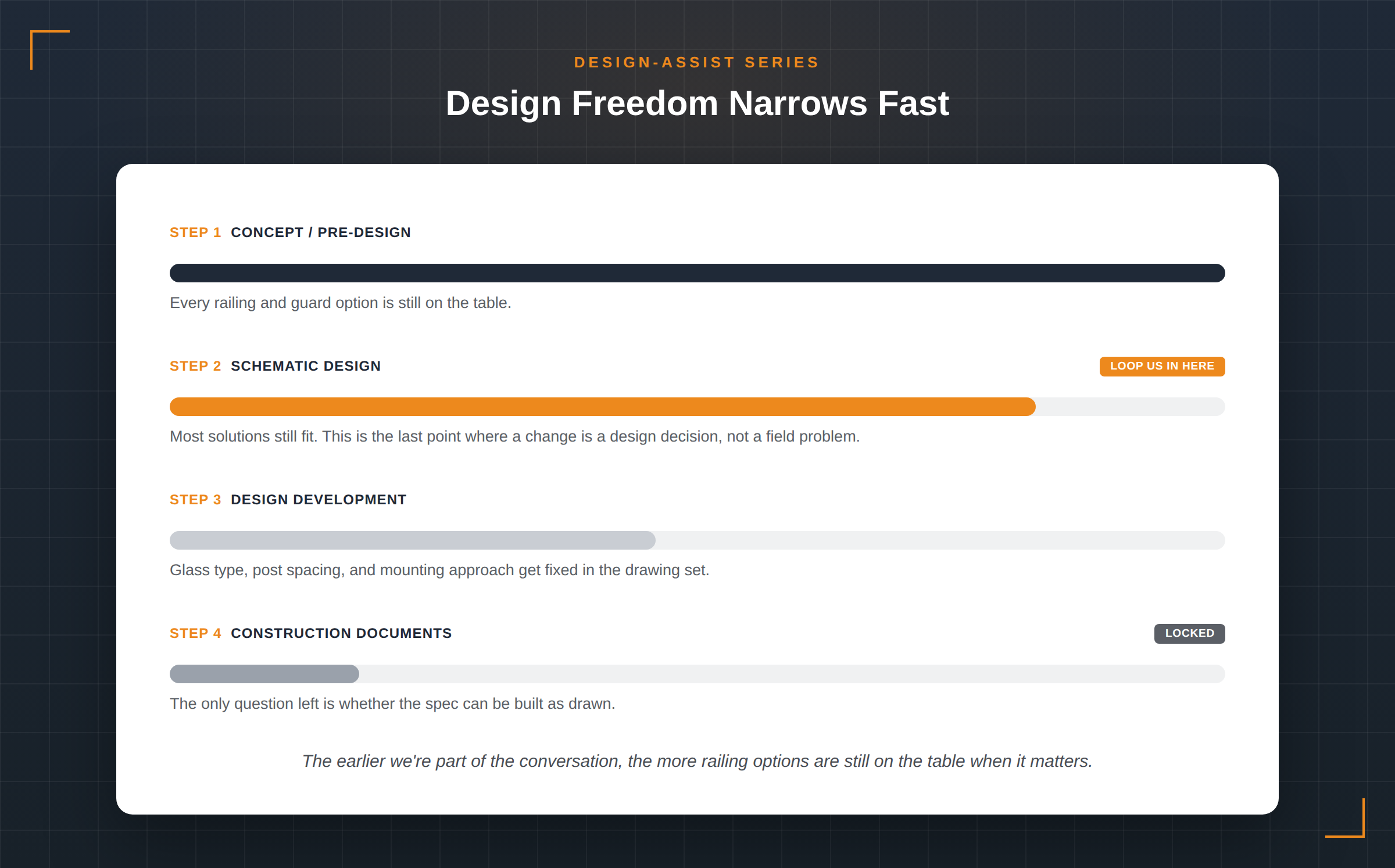
Most railing and architectural metals conversations start too late. Not because anyone drops the ball, but because of when the scope naturally comes up. A schematic design shows a railing system as a single placeholder line on a section detail. Design Development locks in a glass type, a post spacing, a mounting approach. By the time Construction Documents are underway, the only railing conversation left is whether the spec can be built as drawn, not whether a better option ever existed.

That's the gap design-assist is built to close, and the earlier it happens, the more it can actually do.

What "Design-Assist" Actually Means

A design-assist conversation isn't a sales call, and it isn't a submittal review. It's a working session, in person or over a call, where we look at a concept alongside your team and flag what's feasible, what's going to be expensive to change later, and what still has room to move. Nothing needs to be finished. An early pre-design sketch, a schematic section, or a marked-up floor plan showing a stair and guard condition is enough to start from.

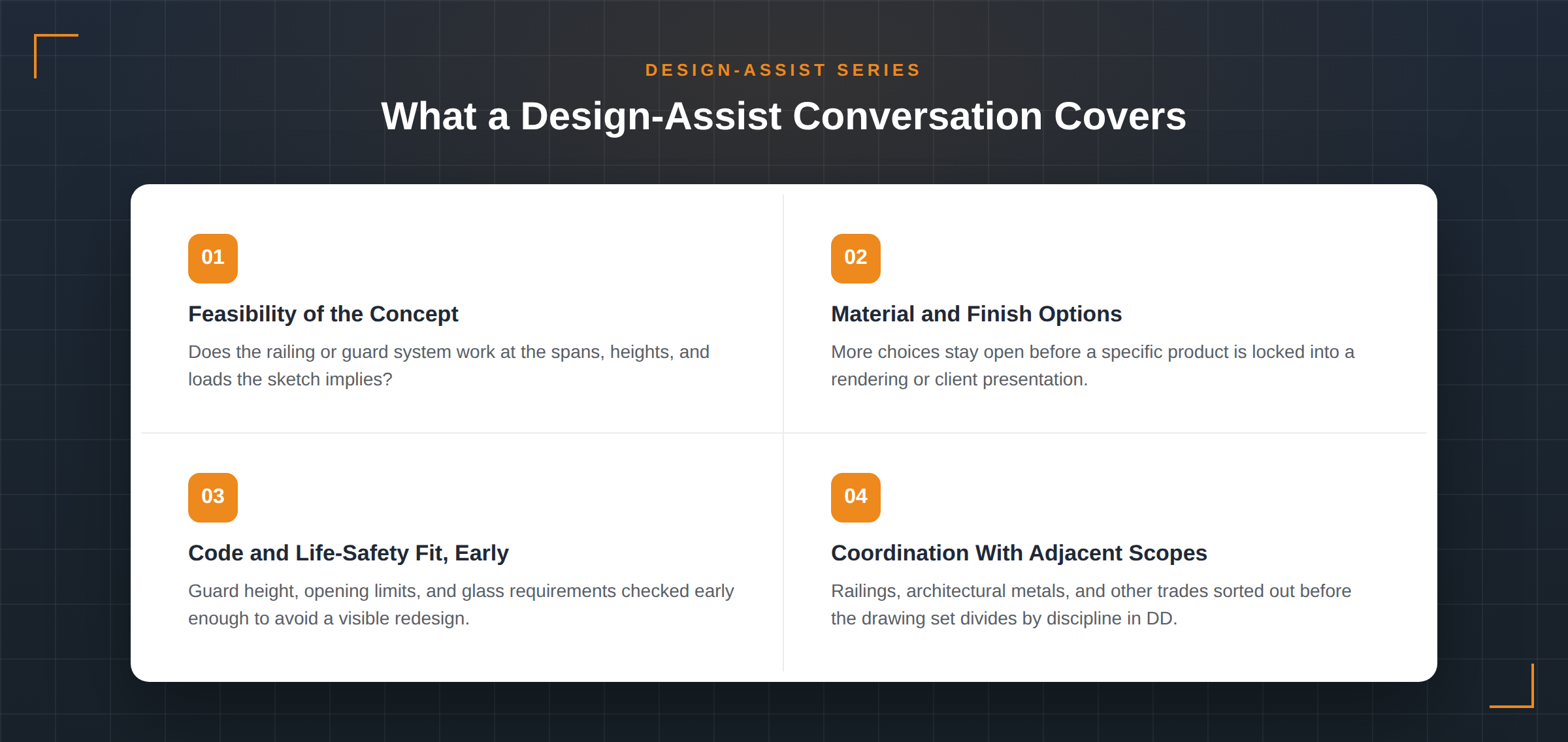
The value isn't that we're smarter about railings than an architect. It's that we see the same conditions across hundreds of projects a year, so we recognize early which details tend to hold up through construction and which ones tend to become change orders. Here's what that conversation typically covers.
1. Feasibility of the Concept as Sketched

Early pre-design and schematic drawings often show a railing or guard system as a clean line, without necessarily working through the spans, heights, or loads that the design implies. A cable rail system that reads well in a rendering may need post spacing tight enough to change the visual rhythm of the elevation. A glass guard at a long, unsupported run may need an intermediate post the design didn't anticipate.

Looking at feasibility this early means those adjustments happen while they're still a design decision, not a field problem. Nobody wants to find out during shop drawing review that the concept as drawn can't actually meet its structural requirements without a visible change.

2. Material and Finish Options While the Field Is Still Open

Once a specific product gets implied in a client presentation or a rendering package, it tends to stick, even if better options exist. A design-assist conversation happens before that narrowing occurs, when laminated versus tempered glass, an interlayer type, or a finish performance standard are all still open questions rather than commitments already made to a client.

This matters more for exterior applications than most people expect. A finish that reads the same color in two different performance classes can behave very differently over a ten-year service life. Getting that decision resolved early, rather than defaulting to whatever a first-pass spec assumed, is a lot easier before it's been presented as final.

3. Code and Life-Safety Constraints, Early

Guard height, opening limitations, handrail graspability and continuity, and the structural loading criteria for handrails, guards, and infill are not places where a design intent can simply override the code. Glass guard assemblies carry their own requirements for safety glazing. Projects that need to meet accessibility provisions have their own extension and continuity requirements for handrails.

None of that is a reason to simplify the design. It's a reason to check it early, while there's still room to adjust a detail without touching the overall concept. A design-assist review flags where a code requirement is going to interact with a design decision, before that decision has been presented to a client as settled.

4. Coordination With Adjacent Scopes

Decorative screens, architectural metal panels, canopies, and feature walls often sit right next to the railing scope on a drawing set, without a clear line dividing who is responsible for what. That's rarely a problem during design. It becomes a problem at bid, when two trades assume the other is carrying a piece of scope, or when a GC's estimators price the same detail twice, or not at all.

A design-assist conversation is a natural point to draw that line. Once it's clear what's included in the railing package and what belongs to an adjacent scope, that boundary can be documented before it ever becomes a bid-day question.

Why Timing Matters More Than Anything Else

Every one of these four conversations is still possible after Design Development. The difference is what's actually on the table when they happen. A design-assist conversation before DD changes what's possible. The same conversation after DD only confirms what's already been decided.

That's not a knock on any specific project delivery method. It's just how design decisions work: the first workable answer to a hard question tends to become the answer, whether or not it was the best one available. The earlier a knowledgeable set of eyes looks at a railing or metals concept, the wider the range of solutions still open.

Get Alexis Involved Early

If you're starting concept work on a project with railings, guards, or architectural metals in the mix, the best time to talk it through is before those decisions get locked into Design Development, not after.

Alexis Dabdoub, National AEC Business Development Manager, can review a concept, flag anything that needs a closer look, and help scope what's feasible while there's still time to adjust it. Schedule a time with Alexis to get a design-assist conversation on the calendar.

Searching
Searching....