Imagine a stairwell that doesn't just move people between floors, but invites them to stop, sit, work, and connect. Wide, open steps blended with bench seating and gathering space. Students studying together on the treads. Employees meeting informally in the middle of the workday. Learning stairs, sometimes called social stairs, are one of the more meaningful trends in commercial architecture over the past decade, and they're reshaping how architects think about the spaces between the spaces.
Learning stairs have become popular features in K-12 institutions, universities, and corporate headquarters. They combine wide, open staircases with seating areas, display spaces, and other features that encourage people to gather, interact, and exchange ideas. What used to be circulation space becomes a multi-purpose environment: informal meetings, study sessions, presentations, or a good place to work between classes.
Well-designed railing systems are essential to making learning stairs work. They provide the safety and code compliance the space needs, contribute to the architectural aesthetic, and often become part of the design language of the stair itself. Here's a real look at how learning stairs work, why railings matter, and how VIVA has delivered railing systems on some of the most notable learning stair projects in the country.
What Is a Learning Stair?
A learning stair (also called a social stair) is an architectural element designed to encourage social interaction and engagement in a building. Learning stairs are characterized by wide, open staircases integrated with seating areas, cushioning, bookshelves, or display space, typically located in high-traffic zones where students, staff, or employees naturally gather.
Learning stairs work as much more than circulation. They provide gathering space for informal meetings and study groups, offer photographic and event opportunities, contribute to emergency egress capacity, and showcase the building's design language in one of the most visible spaces in the facility. In K-12 and higher education contexts, they support the shift toward collaborative learning environments. In corporate contexts, they encourage the kind of unplanned interactions that drive innovation.
The design of a learning stair varies with the specific building and its intended use, but the underlying idea is consistent: turn the stair into a destination, not just a path.
Why Railings Matter for Learning Stairs
Railings on a learning stair carry more responsibility than railings on a standard stairwell. They provide safety at the edges of open seating, contribute to the aesthetic that makes the space work as a gathering place, and support accessibility for every user of the building. Here's how the right railing system delivers on each of those needs.
Safety
Railing systems provide a barrier that helps prevent falls from the edges of the seating and stair treads. On a learning stair where students or employees may be sitting inches from a drop-off, safety is fundamental. Well-engineered railings deliver that safety without making the space feel closed off.
Aesthetics
An aesthetically integrated railing system enhances the visual appeal of the stair and the building around it. Learning stairs are often signature architectural moments, and the railing is part of what makes them read as intentional design. Glass railings dominate here because they preserve sightlines and daylight while contributing a modern, refined aesthetic.
Functionality
Railing systems can be designed to incorporate seating, display spaces, or other functional elements, adding to the overall functionality of the learning stair. The railing isn't just a boundary; it can define zones, support integrated seating, or even accommodate wayfinding.
Accessibility
Railing systems can be designed to meet ADA accessibility requirements, providing support for people with disabilities and making the learning stair accessible to every user. Handrails at code-compliant heights, extensions at the top and bottom of runs, and proper cross-section dimensions all contribute to an inclusive gathering space.
Durability
Learning stairs see heavy use. Stainless steel and aluminum railing systems withstand continuous contact and maintain their aesthetic appeal for decades. Material grade and finish quality matter here: they're what separate a railing that reads as new at year 15 from one that requires refinishing at year 5.
Illuminated Railings
Railings on learning stairs can also be integrated with LED lighting to enhance visibility and create different ambiances. VIVA's iRAIL Linear is an LED-illuminated version of its 1.5-inch ADA-compliant rail, using a roll-formed slotted rail to house a high-performance LED assembly for continuous full-length coverage in warm or bright white with either clear or diffused lenses. iRAIL Pods offer another approach with point-source LEDs spaced 18 to 36 inches on center, ideal for retrofits, vandalism deterrent, or variable lighting levels.
Learning Stair Projects Featuring VIVA Railing Systems
VIVA has delivered railing systems on some of the most notable learning stair projects in the country, from K-12 STEM academies to signature corporate headquarters. Here are seven examples that show the range of what's possible.
PGA of America Headquarters — Frisco, TX
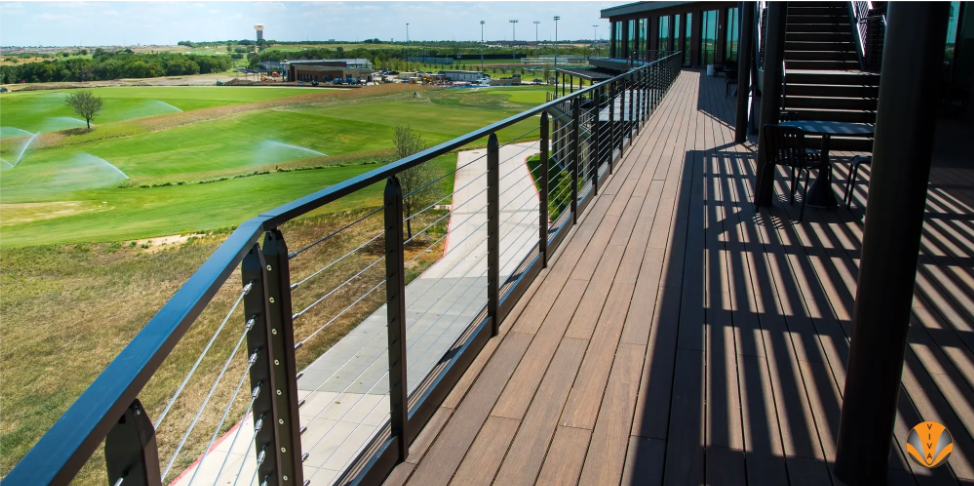
The PGA of America Headquarters in Frisco, Texas features a signature learning stair in the clubhouse with the SHOE Structural Glass Railing System. Structural glass keeps sightlines uninterrupted across the space and reads as intentional, premium design. This is the visual moment that anchors much of the building's interior.
Millikin College Center for Theatre & Dance — Decatur, IL
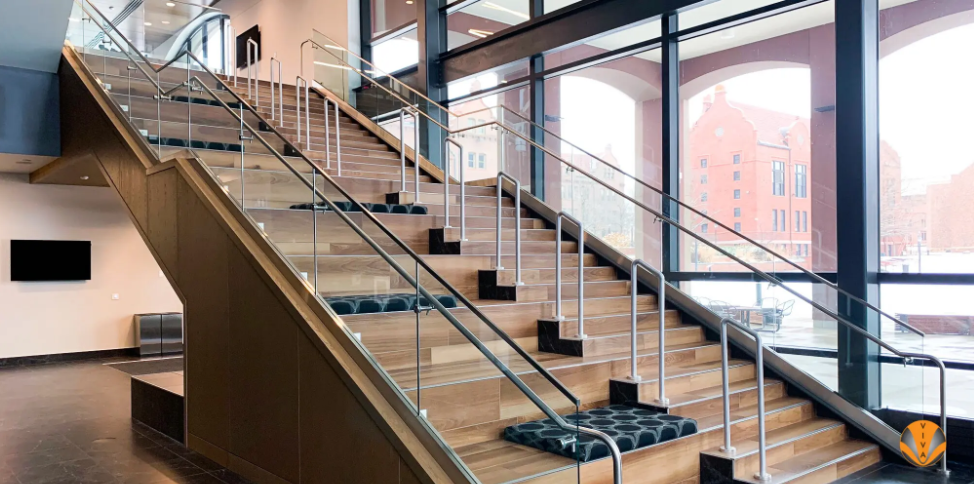
Millikin College's Center for Theatre & Dance in Decatur, Illinois uses the SHOE Structural Glass Railing System combined with an FSR system on its learning stair. The combination delivers the transparent aesthetic the design called for while providing the specific engineering the space required.
Little Elm K-8 STEM Academy — Little Elm, TX
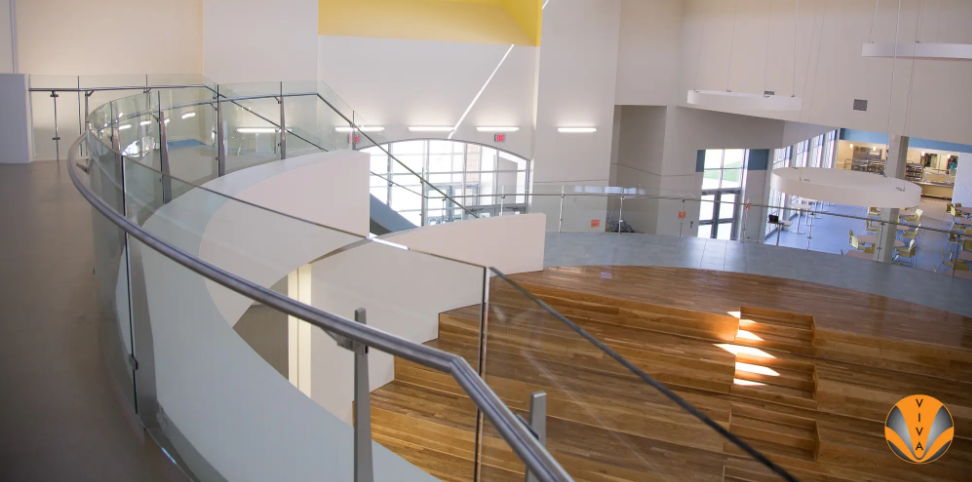
The K-8 STEM Academy in Little Elm, Texas features a beautiful learning stair with a small stair in the center and bench-like seating on either side. VIVA installed the SOLO Glass Railing System alongside the wooden bench structure, blending seamlessly with the architecture to create an inviting study and collaboration space for students.
Texas A&M Zachry Engineering Education Complex — College Station, TX
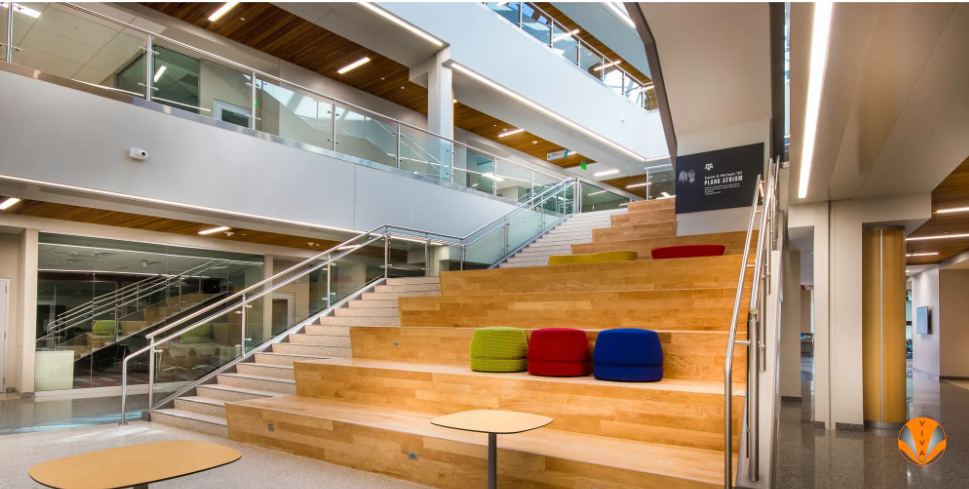
The Zachry Engineering Education Complex at Texas A&M in College Station uses the CIRCA Glass Railing System on its learning stair. The system's post-supported glass delivers the transparency and safety the space calls for while allowing flexibility across the broader engineering education environment.
Norman Central Library — Norman, OK
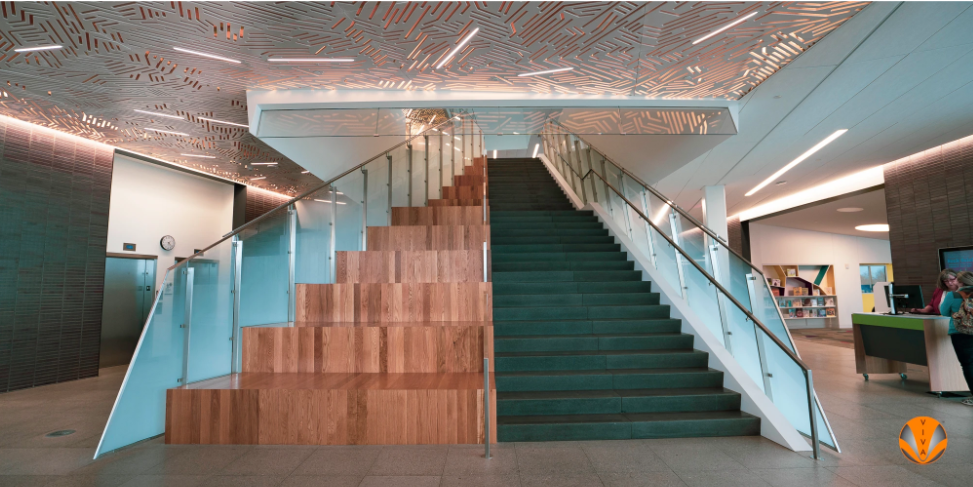
The Norman Central Library in Norman, Oklahoma uses a custom SOLO Glass Railing System with tall glass panels along its learning stair. The custom fabrication approach delivered the specific glass height and configuration the library's design required, tying the learning stair into the broader civic architecture of the building.
Legacy Central II — Plano, TX
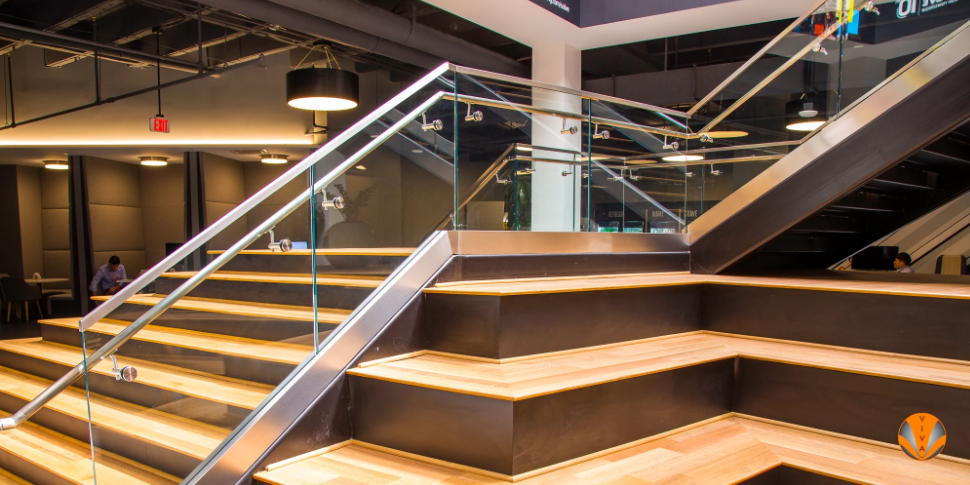
Legacy Central II in Plano, Texas, part of the Samsung headquarters complex, uses the SHOE Structural Glass Railing System on its learning stair. Corporate learning stairs like this one serve as informal meeting and collaboration spaces, and the frameless glass railing delivers the premium aesthetic the corporate environment demands.
Lee Elementary — VISIO Glass Railing
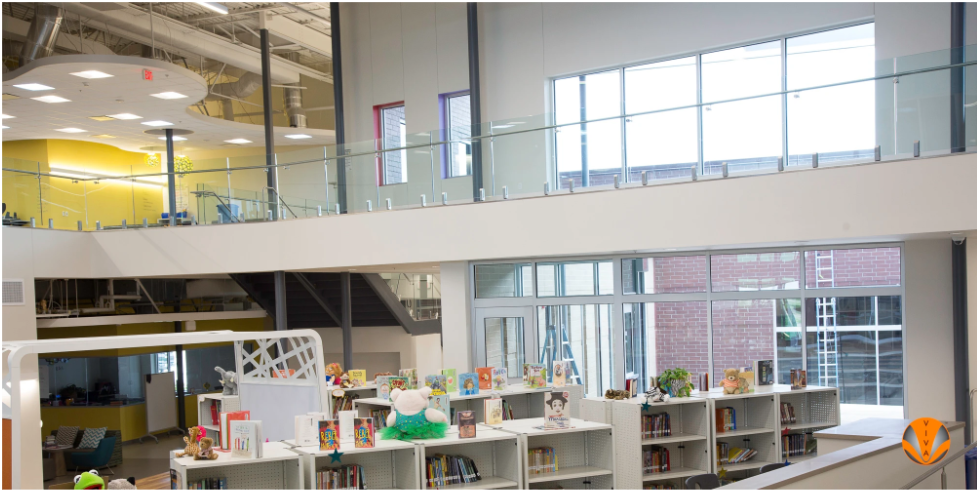
Lee Elementary features a learning stair with a small wooden bench structure blended into the open library area near the entrance of the school, along with a small free-standing rail on the right. VIVA installed the VISIO Glass Railing System to deliver the transparent, unobstructed aesthetic the design called for while providing safety in a K-12 environment.
Where Learning Meets Design
Learning stairs are more than a trend. They represent a shift in how buildings support collaboration, informal learning, and community. In every space where a learning stair works well, the railing system is doing quiet, essential work: providing safety, contributing to the aesthetic, supporting accessibility, and holding up under continuous use.
VIVA has partnered with architects, general contractors, and owners on learning stair projects at every scale, from K-12 STEM academies to signature corporate campuses. Every railing is designed to match the specific architecture of the space, whether that means clear glass, custom wood top rails, colored interlayer, or fully integrated LED lighting. The Design Assist Services page covers what early-stage engagement looks like on learning stair and social stair projects.
Request a Quote or Talk to our Sales Team to work through your project.
Frequently Asked Questions About Learning Stair Railings
What is a learning stair?
A learning stair (also called a social stair) is an architectural element combining a wide staircase with integrated seating, gathering space, and often display or bookshelf areas. They're designed to encourage social interaction, informal learning, and collaboration. Learning stairs are popular in K-12 schools, universities, and corporate headquarters where design intent supports collaborative environments.
What railing systems work best on learning stairs?
Structural glass railings (like VIVA's SHOE system) and post-supported glass railings (like CIRCA Glass and VISIO) are the most common specifications because they preserve sightlines across the open gathering space while providing safety. Custom fabricated systems (like SOLO Glass in curved or tall configurations) work when the design calls for specific geometry. LED-integrated handrails (like iRAIL Linear or iRAIL Pods) can add ambiance and wayfinding to the stair.
Do learning stair railings need to meet ADA requirements?
Yes. Handrails on learning stairs must meet ADA Accessibility Standards for height (34 to 38 inches), cross section (1¼ to 2 inches for circular handrails), continuity, and extensions at the top and bottom of the run. Learning stairs also often require guardrails per IBC where seating or landings are elevated more than 30 inches above the floor or grade below.
Can learning stair railings be customized to match the architectural design?
Yes. VIVA offers full custom fabrication including wood top rails, custom finishes, powder coating in nearly any color, colored interlayer glass, integrated LED lighting, and complete custom-engineered systems for unique geometries. The learning stair is often a signature architectural moment, and the railing is treated as part of the design language, not a bolt-on hardware element.